This ceremony is a representation of the young ब्रह्मचारी | Brahmachari's choice – Married life (Grihastha) or Asceticism (Sanyaasa). To escape his responsibilities, he attempts to sets out to काशी | Kashi, complete with slippers, umbrella, bamboo, fan etc. On his way, the bride’s father intervenes and advises him to pursue गृहस्थाश्रम | Grihasthashram. He assures him that his daughter will help him to face the challenges of life as his life companion. During the vedic wedding ceremony the groom is welcomed as महाविष्णु | Mahavishnu and the bride as महालक्ष्मी | Mahalakshmi.
Vedic Wedding Rituals
Follow along to learn more about the various rituals taking place today, and their religious and cultural significance! And take this QUIZ to test your knowledge!
Saketan and Tess have elected to marry in the Vedic tradition. There are several rituals imbued with deep meaning that comprise this ancient and sacred rite of passage. The below list of rituals will take place during the wedding day, and this blog post is intended to provide context and meaning to what you will witness and participate in.
காசி யாத்திரை | Kasi Yatra - The Groom’s Pilgrimage

வாக்கு நிச்சய முஹூர்த்தம் | Vaak Nichya Muhurtham - The word of the father of the bride
At the wedding venue, the bride’s father and the groom’s father solemnise the final betrothal ceremony.
The priests chant the relevant hymns in which the names of the bride, the groom, as well as the names of their three generations of ancestors are cited in presence of friends, relatives, and invitees.
Both Saketan and Tess will assume vedic names for the ceremony -
श्री रामन | Shri Raman
and
अन्नपूर्णा | Annapoorna
respectively.
மாலை மாற்றல் | Maalai Maatral - Exchange Of Garlands

This is a fun ceremony, where the bride and the groom exchange garlands thrice in a playful manner. The bride and the groom are lifted on the shoulders of their respective uncles (and other relatives) and the two garland each other thrice. A garland worn by a person, should not be used by another, ordain our shastras. But here, the exchange of garlands symbolises their unification – as one soul in two bodies.
ஊஞ்சல் | Oonjal - Swing Ride
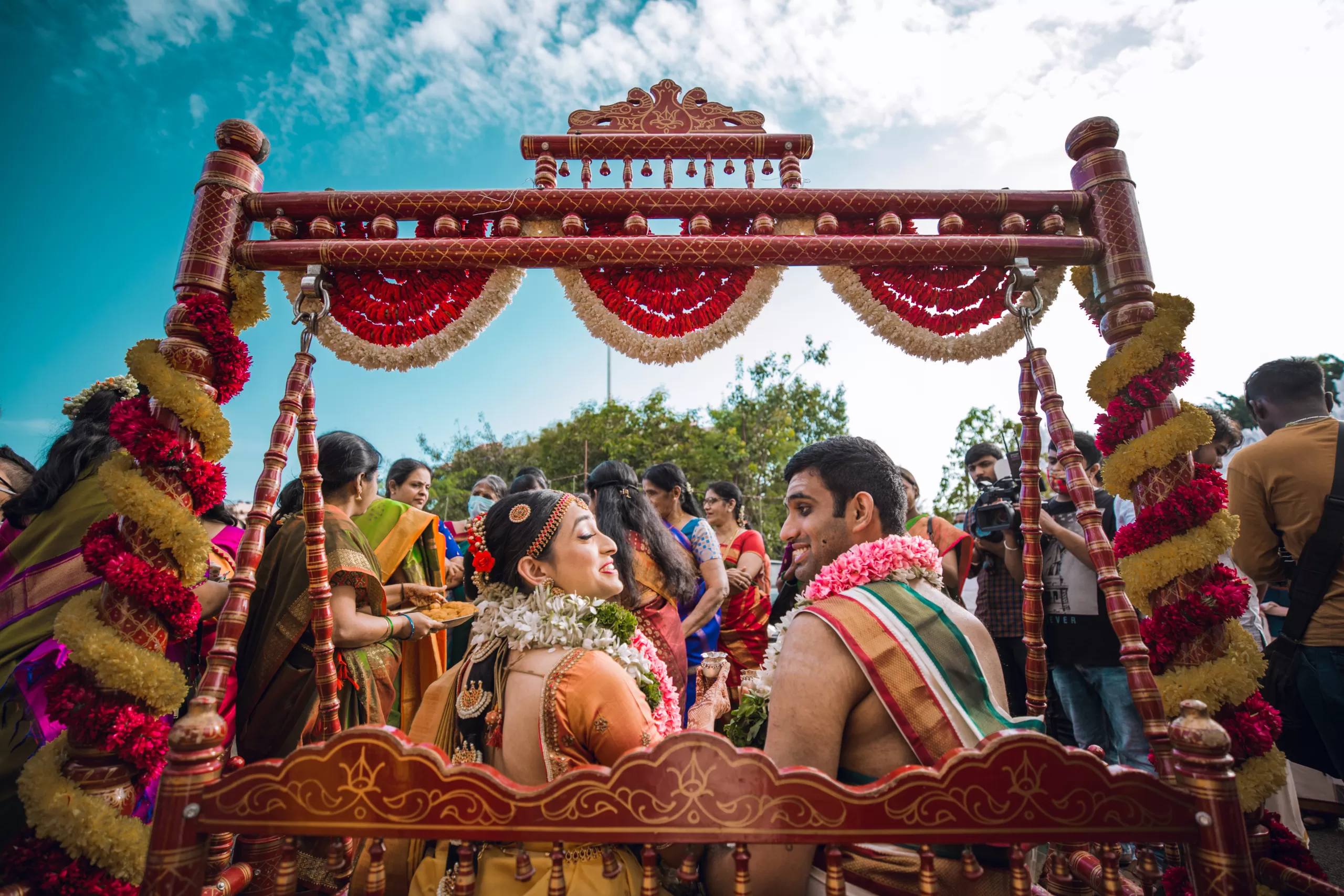
Then, the bridal couple is seated on a swing.
The chains of the swing signify the eternal link with the Almighty above; the to-and-fro motion represents the undulating sea-waves of life and that yet, in mind and body they shall move in harmony unperturbed, steady and stable.
Married women from the families offer spoonfuls of milk and banana fruit pieces to the couple.
They rotate rice balls around the couple in circular motions and fling them away in four different directions to ward off evil.
They also circle the couple four times, holding in their hands a lamp or a container of water.
The feet of the bridal couple - representing
महाविष्णु | Mahavishnu and
महालक्ष्मी | Mahalakshmi
- are washed in milk, and wiped off with silk.
கன்யாதானம் | Kanyadaanam - Giving away the bride
The bride's family welcomes the groom to the மண்டபம் | Mandapam. The bride's father washes his son-in-law's feet, who is supposed to be a representation of महाविष्णु | Mahavishnu. The bride sits by her father and is entrusted by him to the groom. The Mantras chanted at this time, say:
“Let this gold multiply your wealth. Let this water purify your married life and may your prosperity increase. Offer yourself to your husband”
The bride then is given an auspicious ablution. The Mantras chant:
“She standeth here, as one blessed with boons of a good mind, a healthy body, life-long companionship of her husband and children with long life.
She standeth as one who is avowed to stand by her husband virtuously. Be she tied with this reed-grass rope, to the sacrament of marriage.”
Thanksgiving vedic hymns follow, offered to the celestial caretakers of her childhood: the deities of सोम | Soma, गन्धर्व | Gandharva and अग्नि | Agni. 1 The father of the bride chants:
“I offer ye my daughter,
virtuous, good-natured, very wise, decked with ornaments to the best of my
ability; so she may guard the
धर्म | Dharma,
अर्थ | Artha and
काम | Kama.”
Finally, the groom gives the bride's father a word of assurance three times that the he shall remain forever her companion in joy and sorrow – in this life, and after death too.
கங்கண தாரணம் | Kankana Dhaaranam
The bride ties a string fastened to a piece of turmeric, around the wrist of the groom – to bind themselves by a religious vow. It is only after tying the Kankanam that the groom gets the right to touch the bride. A little later, the groom ties a Kankanam on the bride’s wrist.
மாங்கல்ய தாரணம் | Maangalya Dhaaranam

The bride is seated by her father, 2 and the yoke of a farmer's plough is touched to the bride's forehead 3. The groom ties the gold Mangalsutra around her neck. As he does so, the கெட்டி மேளம் | Getti Melam begins. Three knots are tied – the first one by the groom, the other two knots by his sister/s to welcome the bride into the groom’s family. The Vedic hymn recited by the groom when he ties the knot, say:
“Praying to the almighty that I be blessed with a long life, I tie this knot around your neck, may we live together for a hundred years. The three knots symbolise the marriage of the mind, the spirit and the body.”
பாணிக்ரஹணம் | Paani Grahanam - Holding Hands
The groom holds the hand of the bride. The hands are not to be parted till the entire mantra is completed. The Mantras say:
“The Devas have offered you to me in order that I may live the life of a householder; we shall not part from each other even after we grow old.”
सप्तपदी | Saptapathi - Seven Steps
Holding the bride’s hand, the groom walks seven steps with her. This is the most important part of the marriage ceremony, and only when they perform சப்த படி | Sapthapathi is the marriage complete. The mantras recited then, mean:
“Ye who have walked seven steps with me, become my companion, whereby I gain your friendship.
We shall remain together inseparable. Let us make a vow together; we shall share love, share the same food, and share the strength, the same tastes.
We shall be of one mind, we shall observe the vow together. I shall be the Sama, you the Rig; I shall be the Upper
World, you the Earth – together we shall live, beget children, and other riches.”
At each step, (in the earlier days), both ask for blessings:
- ॐ इष एकापदी भव। Om isha ekapadi bhava
- ॐ ऊर्जे द्विपदी भव। Om urje dvipadi bhava
- ॐ रायस्पोषाय त्रिपदी भव। Om rayasposhaya tripadi bhava
- ॐ मयोभवाय चतुष्पदी भव। Om mayobhavaya chatushpadi bhava
- ॐ प्रजाभ्यः पञ्चपदी भव। Om prajabhyaha panchapadi bhava
- ॐ ऋतुभ्यः षड्पदी भव। Om ritubhyaha shatpadi bhava
- ॐ सखा सप्तपदी भव। Om sakha saptapadi bhava
- Bless us with sustenance
- Bless us with strength
- Bless us with prosperity
- Bless us with the source of all bliss
- Bless us with healthy children
- Bless us with enjoying all seasons and longevity
- Bless us with union, devotion and companionship
The ceremony concludes with a prayer that the union is for life. At the end of this, they will be husband and wife.
अग्नि | Agni - The Marriage Fire
The marriage fire is the divine witness as well as sanctifier of the ceremony. A crucial part of the wedding is the homage paid by the couple to अग्नि | Agni. They circle around the fire, and feed it with ghee, and twigs of nine types of trees, as sacrificial fuel. The fumes that arise are supposed to possess medicinal, curative and cleansing effects on the bodies of the couple.
शिला आरोहण | Shila Arohana - Treading on the Grindstone

Holding the bride’s toe on the left foot, the groom helps her tread on a grindstone kept on the right side of the fire. The grindstone signifies a strong and stable foundation for the marriage. It symbolizes that the couple's bond will remain firm even during difficult times. The ritual is also seen as a way for the groom to show humility and respect for his bride. The Mantras say:
“Mount up this stone. Let thy mind be rock firm unperturbed, by the trials and tribulations of life.”
அருந்ததி தர்ஷனம் | Arundhati Darshanam - Viewing the Arundhati Star
Next, the bride and groom look at the वशिष्ठ | Vashishtha and अरुंधति | Arundhati stars as a symbolic act representing marital fulfillment and loyalty. Their visible proximity led to the traditional understanding of them revolving around each other, embodying mutual support, equality, and steadfast companionship in marriage. It's a testament to ancient Indian astronomy that they recognised these two distinct points of light and assigned such profound meaning to their apparent relationship. This ritual emphasizes the importance of mutual respect, understanding, and a harmonious partnership between husband and wife.
லாஜ ஹோமம் | Laaja Homam
This comprises the bride’s own offering to the sacrificial fire. She offers a handful of parched rice grains into the fire. Through this food offering, the bride seeks a long life for her husband, and propagation of the family. Participation of the bride’s family members indicates the continuance of links between the two families, even after marriage. The couple circle around the fire, three times, and the feeding of the fire with parched rice, is repeated thrice.
அக்ஷதை | Akshadai - Showering of Blessings
अक्षत | Akshata are to be showered on the couple, by elders and invitees – as benediction. The bride and groom seek the blessings of the senior members of the family by prostrating before them. They also offer them a gift of fruits and a token rupee.